

Doctorate of Philosophy in Law
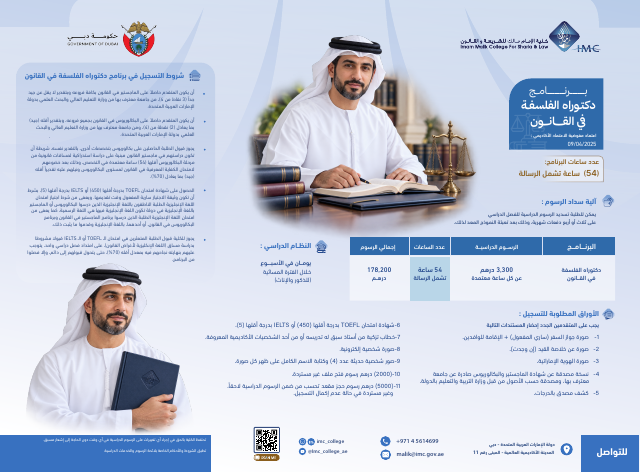 Program brochureDownload PDF
Study plan for the Doctorate of Philosophy in Law program
Program Specifications
- Objectives and Outcomes of the Doctorate of Philosophy in Law Program
| Objectives | Outcomes | Five Domains of Learning Outcomes in the National Qualifications Framework | Level 9 Qualifications Framework Competencies |
|---|---|---|---|
| 1- Devise practical solutions to emerging legal issues. | 1- Derives legal solutions to legal questions and problems related to the student's field of specialization. | 2- Skills; 3- Autonomy and responsibility | - Advanced skills in devising innovative solutions to research problems; - Acting with responsibility, creativity, autonomy and scientific integrity |
| 2- Study different legal systems. | 2- Compares different legal systems. | 1- Knowledge; 2- Skills | - New, innovative knowledge created through research and development in an in-depth field of knowledge; - Advanced skills in devising innovative solutions to research problems |
| 3- Develop the ability to make appropriate decisions to solve legal problems related to the student's field of specialization. | 3- Analyzes the relevant legal texts, judicial rulings and jurisprudential opinions. | 3- Autonomy and responsibility; 4- Role in context | - Acting with responsibility, creativity, autonomy and scientific integrity; - Ability to establish and manage complex scientific processes |
| 4- Communicate effectively with work teams and strengthen the spirit of leadership. | 4- Leads a work team to present solutions to legal questions related to the student's field of specialization. | 4- Role in context; 5- Self-development | - Ability to establish and manage complex scientific processes; - Ability to analyze and critique at an advanced level in a specialized field |
| 5- Equip the student with specialized scientific research skills in legal studies. | 5- Prepares scholarly research in the student's field of study in accordance with the principles of scientific research. 6- Writes a scholarly thesis on one of the emerging legal topics in the field of specialization. | 3- Autonomy and responsibility; 4- Role in context; 5- Self-development | - Acting with responsibility, creativity, autonomy and scientific integrity; - Ability to establish and manage complex scientific processes; - Ability to analyze and critique at an advanced level in a specialized field |
- Graduation requirements:
Students must fulfill the following requirements in order to obtain the Doctorate of Philosophy in Law:
1- Successful completion of all credit hours of the program, totaling (54) credit hours.
2- Obtaining a cumulative grade point average of at least (3) out of (4) upon completion of their studies.
3- Spending the minimum period of residence in the program, estimated at (3) years, equivalent to (6) regular semesters, and not exceeding the maximum period of residence in the program, estimated at (6) years, equivalent to (12) regular semesters.
- Components of the Doctorate of Philosophy in Law program:
| Doctorate of Philosophy in Law | Compulsory | Elective | Total |
|---|---|---|---|
| Courses | 12 | 12 | 24 |
| Scholarly thesis (dissertation) | 30 | - | 30 |
| Total credit hours | 42 | 12 | 54 |
- List of courses:
A – Compulsory program course requirements
| Course No. | Course Name | Prerequisite | Credit Hours | Course Offered: Level | Semester |
|---|---|---|---|---|---|
| 6220206 | Legal Research Methods | - | 3 | First | First |
| 6320514 | Comparative Law and Contemporary Legal Systems | - | 3 | First | First |
| 6230207 | Legal Studies in English | - | 3 | First | Second |
| 6310520 | Philosophy of Law | - | 3 | First | Second |
| Total credit hours | 12 |
B – Elective program course requirements (Private Law basket) (students select 12 credit hours)
| Course No. | Course Name | Prerequisite | Credit Hours | Course Offered: Level | Semester |
|---|---|---|---|---|---|
| 6110101 | Civil Transactions Law | - | 3 | First | First |
| 6110202 | Commercial Transactions Law | - | 3 | First | First |
| 6110308 | Private International Law | - | 3 | First | First |
| 6210309 | Civil Procedure Law | - | 3 | First | Second |
| 6220410 | Law of Evidence in Civil and Commercial Transactions | - | 3 | First | Second |
| 6220311 | Labor Law and Social Legislation | - | 3 | First | Second |
| 6320615 | Arbitration Law (E) | - | 3 | Second | First |
| 6320512 | Company and Bankruptcy Law | - | 3 | Second | First |
| 6310513 | Banking Operations (E) | - | 3 | Second | First |
| Total credit hours | 12 |
C – Elective program course requirements (Public Law basket) (students select 12 credit hours)
| Course No. | Course Name | Prerequisite | Credit Hours | Course Offered: Level | Semester |
|---|---|---|---|---|---|
| 6110903 | Administrative Law | - | 3 | First | First |
| 6110315 | Financial and Economic Legislation | - | 3 | First | First |
| 6210316 | Constitutional Law and Political Systems | - | 3 | First | First |
| 6210104 | Penal Code | - | 3 | First | Second |
| 6220105 | Public International Law (E) | - | 3 | First | Second |
| 6220417 | International Humanitarian Law (E) | - | 3 | First | Second |
| 6220318 | Tax Legislation | - | 3 | Second | First |
| 6320519 | Emerging Crimes | - | 3 | Second | First |
| 6320521 | Criminal Procedure Law | - | 3 | Second | First |
| Total credit hours | 12 |
| Total credit hours for taught courses | 24 |
|---|
7- Scholarly Thesis (Dissertation):
A – Compulsory program course requirements
| Course No. | Course Name | Prerequisite | Credit Hours | Course Offered: Level | Semester |
|---|---|---|---|---|---|
| 6410121 | Registration of the Scholarly Thesis (Dissertation) | Completion of at least 21 credit hours of coursework with a cumulative grade point average of at least 3 out of 4, and passing the knowledge adequacy examination at doctoral level in the Private Law or Public Law track with a grade of at least 3 out of 4 | 0 | Second | First |
| Defense of the scholarly thesis (dissertation) | Completion of the 24 credit hours allocated to coursework with a cumulative grade point average of at least 3 out of 4, publication of two peer-reviewed research papers in refereed scientific journals, one of them in a journal classified in Category (A), and spending the minimum period of residence in the thesis, estimated at (4) semesters, without exceeding the maximum period of residence in the program, estimated at (12) regular semesters | 30 | Third | Second | |
| Total credit hours | 30 |
| Total credit hours for the program | 54 |
|---|
8- Admission requirements:
The following are required for the admission of students to the Doctorate of Philosophy in Law:
1- Holding a master's degree in law in all its branches with a grade of at least Very Good (3 points out of 4) or its equivalent, provided that the student holds a bachelor's degree in law with a grade of at least Good from a university recognized by the Ministry of Higher Education and Scientific Research of the United Arab Emirates.
2- Holding a bachelor's degree in law in all its branches with a grade of at least Good, equivalent to (2) points out of (4). Students holding bachelor's degrees in other specializations may also be admitted with the same grade, provided that their study in the Master of Law is based on a remedial study of legal courses from the bachelor's level, amounting to at least (54) credit hours in the specialization, after they have sat the knowledge adequacy examination in law at bachelor's level and obtained a grade of at least Good, equivalent to 70%.
3- Passing the TOEFL test with a score of at least (450), or the IELTS test with a score of at least (5), provided that the certificate is valid at the time of submission.
4- Students who are native English speakers and who studied their bachelor's or master's degree in English in a country where English is the official language are exempt from the advanced English language test.
5- Students who studied the Master of Law program and/or the Bachelor of Law program in English, and who provide proof of this, are also exempt from the advanced English language test.
- Submission of two letters of recommendation from two professors who have previously taught them at master's level.
7- A copy of the curriculum vitae of students applying to register in the program.
8- A letter of no objection from the authorities responsible for national service for male citizen students.
9- A copy of the People of Determination card, if the applicant is a person of determination.
10- A letter of no objection to enrollment in the program from the employer, if the applicant is an employee.
- Description of the courses:
A- Compulsory courses
| Course Name | Legal Research Methods |
| Course No. | 6220206 |
| This course includes the following topics: rules and principles for preparing scholarly legal research; the methods, functions and objectives of legal research; legal research techniques; the practical writing of legal research and the strategy required to carry it out; the principles that must be observed in writing it in terms of form and substance; drawing conclusions and presenting recommendations. The course also trains the student in how to use sources and references, and refers to the most important legal websites on the internet for extracting information, in addition to following up on practical application. |
| Course Name | Comparative Law and Contemporary Legal Systems |
| Course No. | 6320514 |
| This course addresses the subject of comparative law and its relationship with contemporary legal systems, and contains an in-depth study of the following topics: First, concepts: - The concept of comparative law: its definition, the determination of its forms, and the identification of its nature and importance. - The methods and approaches adopted in studying comparative law, in particular the foundations of these methods and approaches, the developments they have undergone, and all the stages of the adopted comparative research. - The concept of the contemporary legal system: its definition and the classification of legal systems. - Linking comparative law to the objectives of contemporary legal systems. Second, experiences. There are four: - The first experience: legal systems based on judicial precedent, in particular: o the English legal system o the American legal system - The second experience: legal systems based on legislative texts, in particular: o the French legal system o the German legal system - The third experience: the Islamic legal system: o its characteristics o the problem of its codification - The fourth experience: Arab legal systems: o their frame of reference o their content o their risks |
| Course Name | Legal Studies in English |
| Course No. | 6230207 |
| This course deals with the study of various legal topics from the specializations of public law and private law, in English. It comprises precise specializations selected from the branches of public law and private law, along with research hours in which students are required to prepare in-depth, systematic research based on readings from the most important legal references in English. |
| Course Name | Philosophy of Law |
| Course No. | 6310520 |
| This course contains the following topics: General curriculum: This course covers topics related to the philosophy of law, beginning with an explanation of the meaning of philosophy and the meaning of the philosophy of law; the relationship between the philosophy of law and legal history; the stages in the development of the concept of law, its objectives, functions and relationship with other sciences; the interpretation of law; the relationship between Islamic philosophy and the philosophy of law; the philosophy of law and jurisprudential rules; the sources of the legal rule and its interpretation; legislative philosophy in the laws of the United Arab Emirates; natural law; the rules of justice and equity; and the notion of public order and public morals. Specific curriculum: After the course instructor highlights the topics of the general curriculum, the instructor selects one of them and begins to expand on it, such as the influence of the laws of the United Arab Emirates by Islamic Sharia and natural law, and the codification of the most important jurisprudential rules to assist in interpreting the legal text. |
B- Elective courses (Private Law basket)
| Course Name | Civil Transactions Law |
| Course No. | 6110101 |
| General curriculum: This course covers the study of some important topics relating to the philosophy of personal rights, real rights and intellectual rights; the role of the will within the scope of personal rights; the legal regulation of this role through the voluntary sources of obligation; the constituent elements of the non-voluntary sources of obligation, namely harmful acts and unjust enrichment; the philosophy of objective civil liability; the role of the will in the extinction of obligations; the means available to the creditor to protect their right; monitoring of the debtor's financial position; real rights, and the philosophy of regulating ownership in the Civil Transactions Law; and the philosophy of pledge in its two forms, security pledge and possessory pledge. Specific curriculum: An in-depth study of one or more topics of the Civil Transactions Law, the selection of which is subject to the course instructor, such as models of emerging contracts or professional liability. |
| Course Name | Commercial Transactions Law |
| Course No. | 6110202 |
| This course contains the following topics: General curriculum: This course is concerned with the study of commercial and economic legislation, as well as legislation relating to investment, and the impact of these laws on development and investment in the United Arab Emirates in particular. It is delivered through interactive discussion circles, in which students present and discuss their ideas, with the aim of enriching critical and analytical thinking in the field of commercial law. Specific curriculum: In-depth study of one or more of the following issues: 1- The legal regulation of emerging digital currencies in UAE and comparative legislation. 2- Legal protection of foreign investments in the UAE. 3- Licensing for the use of trademarks. 4- The legal regulation of trade names. The course is covered through study of the theoretical and practical aspects, preparation of research papers and work reports for discussion and comment, in order to enrich analytical thinking in law, and through interactive discussion circles on the topics raised, in order to reach results and recommendations to be presented to the relevant competent authorities. |
| Course Name | Private International Law |
| Course No. | 6110308 |
| This course provides an in-depth study of private international law, addressing one of the following topics: the law applicable to emerging contracts, such as smart contracts, and the role of conflict of laws in the field of artificial intelligence and its ramifications; substantive rules; the theory of conflict of laws in Islamic Fiqh; the law applicable to, and jurisdiction over, relationships conducted via the internet; the law applicable to international trade contracts and international investments, and the role of substantive rules; the law applicable to sports disputes; the law applicable to personal status disputes; and finally nationality and the status of foreigners, and their intersection with the problem of conflict of laws and judicial jurisdiction. |
| Course Name | Civil Procedure Law |
| Course No. | 6210309 |
| This course covers a number of topics, focusing as far as possible on the new aspects of the Civil Procedure Law, as follows: First: General curriculum: the definition of civil procedure law, its subjects, its scope of application and its relationship with other procedural laws; the rules relating to the foundations of litigation and fair trials; the rules of jurisdiction and judicial competence; the theory of the litigation, its incidents and the related legal defenses; judgments and orders, how they are issued and the methods of appeal against them; and the rules and procedures of compulsory enforcement and its disputes. Second: Specific curriculum: the study of one or more topics of the general curriculum in greater detail, depth and comprehensiveness, covering all their aspects, and in line with all legislative, jurisprudential and judicial developments in the various procedural aspects, for the benefit of procedural legal thought, contributing to its development and enrichment, and positively influencing the development of the legal and judicial community at all levels. |
| Course Name | Law of Evidence in Civil and Commercial Transactions |
| Course No. | 6220410 |
| This course contains the following topics: General curriculum: The course covers the general principles of proof in civil and commercial claims, and the direct and indirect means of proof. Among the direct means, the student studies written evidence (official and private documents), witness testimony, inspection and expert opinion. Among the indirect means, the student learns about legal and judicial presumptions, judicial and extrajudicial admissions, and the decisive and supplementary oath. At the end of the means of proof, electronic means of proof are studied. Specific curriculum: A detailed study of the rules relating to the subject of proof or the burden of proof, or a study of the provisions relating to one of the means of proof prescribed by law, and a study of electronic means of proof, the electronic signature, and their probative force. |
| Course Name | Labor Law and Social Legislation |
| Course No. | 6220311 |
| This course covers: General curriculum: an explanation of the provisions of UAE labor law. The legislator regulated employment relations under Federal Decree-Law No. (33) of 2021 on the Regulation of Employment Relations; Federal Decree-Law No. (14) of 2022 amending certain provisions of Federal Decree-Law No. (33) of 2021; Federal Decree-Law No. (20) of 2023 amending certain provisions of Federal Decree-Law No. (33) of 2021; its Executive Regulation issued by the Cabinet under Resolution No. (1) of 2022; and the decisions issued in implementation thereof. The study presents its provisions in accordance with the most recent amendments, together with related decisions of the Minister of Human Resources and Emiratization, such as Ministerial Resolution No. 42 of 2022 on wage protection; Ministerial Resolution No. (48) of 2022 regulating labor inspection procedures; Ministerial Resolution No. (27) of 2022 on the labor inspection procedures manual; Cabinet Resolution No. (46) of 2022 establishing the Collective Labor Disputes Committee; and Ministerial Resolution No. (787) of 2017 on regulating remote work. Reference will also be made to Federal Decree-Law No. (9) of 2022 on auxiliary service workers (domestic workers). Specific curriculum: An in-depth study of one or more topics of labor law, such as the remote work contract, the legal protection of domestic workers, and the settlement of collective labor disputes. |
| Course Name | Arbitration Law (E) |
| Course No. | 6320615 |
| This course contains the following topics: General curriculum: A study of the most important aspects of arbitration, such as the arbitration agreement and its types, the basic principles governing its procedures, the law applicable to the procedures or to the subject matter of arbitration, and the nullity and enforcement of arbitral awards. Specific curriculum: In-depth study of one of the above topics, or of any of the following: the law applicable to arbitration disputes; arbitration in Islamic finance; the particularities of the law applied before Islamic arbitration centers; arbitration in intellectual property disputes; arbitration in international trade and electronic commerce contracts, maritime commercial disputes, and international sports disputes; and the problem of annulment of an arbitral award and the difficulties of enforcing foreign arbitral awards, such as the enforcement of a null foreign arbitral award. |
| Course Name | Company and Bankruptcy Law |
| Course No. | 6320512 |
| This course contains the following topics: General curriculum: The general framework of this course covers recent topics in company and bankruptcy law at the national and regional levels, such as the study of the theory of the company contract and its effect on promoting development and investment. It focuses generally on companies, their development, provisions, types, liquidation, and the mechanisms for protecting distressed commercial enterprises from bankruptcy. Specific curriculum: In-depth study of one or more of the following issues: 1- The legal regulation of oversight of the actions of the board of directors of public joint stock companies. 2- The legal system for the transformation of companies. 3- Company mergers. 4- Mechanisms for protecting commercial enterprises from bankruptcy (restructuring). 5- Preventive composition (settlement) to avoid bankruptcy. The course is covered through study of the theoretical and practical aspects, preparation of research papers and work reports for discussion and comment, in order to enrich analytical thinking in law, and through interactive discussion circles on the topics raised in company and bankruptcy law, in order to reach results and recommendations to be presented to the relevant authorities. |
| Course Name | Banking Operations (E) |
| Course No. | 6310513 |
| This course contains the following topics: General curriculum: This course is concerned with the study of banking operations and their role in bank credit operations, their impact on economic development in the United Arab Emirates in particular, and their practical applications. It also addresses the legislation relating to banks and the supervision of banking operations. Specific curriculum: In-depth study of one or more of the following issues: 1- Documentary credit (its legal regulation, and the rules and international customs that govern it). 2- Bank guarantee letters. 3- Current accounts. 4- Bank guarantees and bank transfers. The course is covered through study of the theoretical and practical aspects, preparation of research papers and work reports for discussion and comment, in order to enrich analytical thinking in law, and through interactive discussion circles on the topics raised, in order to reach results and recommendations to be presented to the relevant competent authorities. |
C- Elective courses (Public Law basket)
| Course Name | Administrative Law |
| Course No. | 6110903 |
| This course contains the following topics relating to economic administrative law: - The nature of economic administrative law: its definition, origin, characteristics and sources. - Economic administrative organization at the level of central and non-central institutions. - Through addressing the legal framework of state intervention in the economic field, the course covers: the principles governing state intervention in the economic field; the mechanisms of state intervention in the economic field; the place of competition (law and institutions) in economic activity; and the role of the state in the economic field. - The course also addresses the economic public sector: its definition, characteristics, origin and development; its relationship to the evolution of state functions; the concept of the economic public institution; the laws regulating the public sector; the concept of economic public order; and the concept of independent administrative authorities. |
| Course Name | Penal Code |
| Course No. | 6210104 |
| This course is devoted to an in-depth study of selected issues of the Penal Code in both its general and special parts. It includes issues from the General Penal Code in its two divisions, crime and punishment, and issues from the Special Penal Code in its two divisions, crimes against property and crimes against persons. It includes an in-depth study of one of the topics of criminal law, such as the general theory of criminal intent; the philosophy of punishment in Islamic Sharia; physical punishments and their effect on combating crime; and contemporary criminal policy: a comparative study. |
| Course Name | Public International Law (E) |
| Course No. | 6220105 |
| This course contains the following topics: General curriculum: the study of some important topics in public international law, such as maritime zones under the law of the sea, international responsibility, and diplomatic and consular relations. Specific curriculum: an in-depth study of one or more topics of public international law, such as state immunity, succession of States, unilateral acts of States, sustainable development in international law, and the law of outer space. |
| Course Name | Financial and Economic Legislation |
| Course No. | 6110315 |
| This course involves an in-depth study of some contemporary economic and financial systems and legislation, such as the relationship between tax policy and the economic systems applied; the relationship between tax policy, economic policies and investment; as well as competition and anti-monopoly legislation and anti-dumping legislation. Attention is paid to new aspects in the field of economic and financial legislation, with application to the United Arab Emirates. |
| Course Name | Constitutional Law and Political Systems |
| Course No. | 6210316 |
| This course deals with the sources of constitutional law and contains an in-depth study of the following topics: - The concept of the sources of law, and the distinction between material sources and formal sources of law. - The material sources of constitutional law, in particular: history, politics, religion, sociology, economics and constitutional inspiration. - The formal sources of constitutional law, whether official and written sources (the constitution, ratified international treaties, legislative texts, and regulations), or unwritten sources (constitutional custom, general principles of law, judicial jurisprudence, and constitutional doctrine). - The importance of ensuring the supremacy of the constitution, in particular: the constitutional institution entrusted with guaranteeing and protecting the supremacy of the constitution; the mechanisms adopted to ensure the supremacy of the constitution; and the effects arising from decisions issued to guarantee and respect the constitution. |
| Course Name | International Humanitarian Law (E) |
| Course No. | 6220417 |
| This course contains the following topics: General curriculum: the definition of international humanitarian law; the historical development of the theory of war; the evolution of the concept of international and non-international armed conflict; and the conventions governing international humanitarian law. Specific curriculum: an in-depth study of one or more topics of international humanitarian law, such as private military companies in armed conflict; the use of advanced military technologies in armed conflict (unmanned aerial vehicles); the principles of international humanitarian law; the participation of non-State entities in armed conflict; and the protection of civilian populations during armed conflict. |
| Course Name | Tax Legislation |
| Course No. | 6220318 |
| This course deals with the most important organizational aspects of financial legislation in the United Arab Emirates, such as clarifying the types of sovereign public revenues and non-sovereign public revenues, and analyzing the financial sovereignty of the State as exercised in the tax field. It focuses on the decisive role of taxes in public finance, economic development and social justice. |
| Course Name | Emerging Crimes |
| Course No. | 6320519 |
| This course is devoted to studying some issues of emerging crimes in special penal legislation. It contains issues from the general criminal law in its two divisions, crime and punishment. It also contains a study of models of some emerging crimes, including cybercrimes, through their definition, elements, forms and types, and the difference between them and traditional crimes under Federal Decree-Law No. (34) of 2021 on combating rumors and cybercrimes. It also covers crimes related to emerging subjects, such as crimes relating to artificial intelligence, electronic consumer protection, or money laundering through social media. |
| Course Name | Criminal Procedure Law |
| Course No. | 6320521 |
| This course contains the following topics: General curriculum: the study of the general principles of criminal procedure through the stages of evidence gathering, preliminary investigation and trial, and the methods of appeal against judgments, with a focus on the principles relevant to the subject taught in the specific curriculum. Specific curriculum: the study of the special provisions governing the conduct of criminal proceedings; the rules of evidence, especially in models of emerging crimes; and the methods of appeal against judgments. The study is in-depth and comparative, and focuses on modern topics in the specialization, such as alternatives to criminal proceedings (the penal order and conciliation in criminal matters, among others), and the authority of electronic evidence in criminal proof, in terms of the rules of criminal proof in comparative legal systems. The course instructor selects one of these topics. |